
Overview
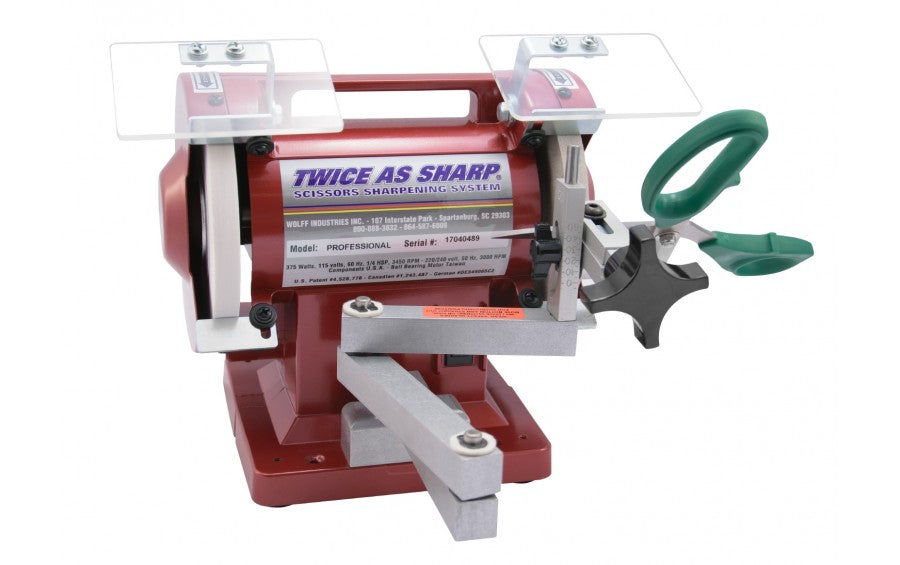
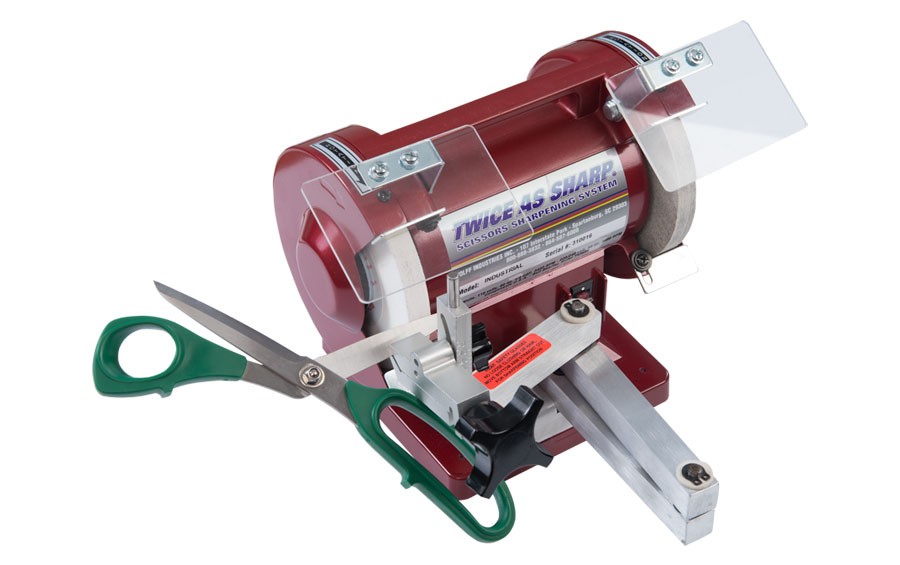
The Twice as Sharp® Professional Scissors Sharpener is designed to make sharpening your customer's shears fast, easy, and precise. The professional system comes equipped with a 100 grit sharpening wheel so you can sharpen customer's shears quickly. A professional honing wheel is also included to highly polish your edge leaving a shiny cosmetic finish. The professional honing wheel is designed for pet grooming shears, high quality fabric shears, and low priced barber and beauty shears.
The Twice as Sharp® Professional Scissors Sharpener also comes fitted with an arm and clamp assembly that can be set to match all possible angles on any industrial scissors, grooming shear, or low-end beauty and barber shear up to 14 inches in length. This will allow you to confidently sharpen any shear to the exact angle best suited to your customer’s needs. If you ever have questions about angles or how to sharpen different styles of shears, the Professional Twice as Sharp® comes with an in-depth manual that lists many of the best angles for each different style. If you need more help, give us a call for additional support.
All of Wolff Industries’ scissors sharpeners come with a comprehensive training DVD that will walk you through the steps of sharpening numerous shears. This exhaustive training tool will teach you how to properly use your new sharpener and produce quality results every time!
Features
Did you notice?
Recommended For
Pet grooming shears, high quality fabric shears, low priced barber and beauty shears.
High or low volume scissors sharpening
Retail, home, or industrial use
What's in the Box?
Twice as Sharp® Standard Scissors Sharpener
Standard Sharpening Wheel
Professional Honing Wheel
Standard Shears-Lock Clamp
Angle Gage
Pink Hone
Scissors Lubricant
Wheel Dresser
Hex Wrench
Sales Poster
Eyeshields
Safety Glasses
Dust Mask
Operator's Manual
Training DVD
Technical Specifications
CSA Certified - CSA C22.2 No 71.2-M89 - Electric Bench Tools and UL 987, Sixth Edition - Stationary and Fixed Electric Tools
U.S. Patent # 4,528,778
Canadian Patent # 1 243 487
German Patent # DE 3490 065 C2
Specifications subject to change without notice
Origin
Components - Manufactured and Assembled with pride in the U.S.A.
Ball Bearing Motor - Manufactured in Taiwan
Warranty
Buy with confidence. Wolff Industries, Inc. Twice as Sharp® scissors sharpeners come with our best warranties.
30 Day Money Back Guarantee: If you are not completely satisfied, return the item(s) within 30 days to receive a prompt refund. Returns after 30 days are subject to a 10% restocking fee. Wolff Industries, Inc. reserves the right to make changes or improvements on its products without incurring an additional obligation to make corresponding changes or improvements to products previously manufactured or sold. Wolff Industries, Inc. reserves the right to discontinue products at any time without notice.
Limited Warranty: Two year warranty from date of purchase against defective parts or workmanship with the exception of the sharpening, buffing, honing and polishing wheels. Warranty limited to replacement of parts. Buyer must return warranty card to manufacturer for coverage of warranty. This warranty covers only the original purchaser. Use of non-factory parts voids any warranty. This warranty gives you specific rights. You may also have other rights which may vary from state to state. Some states do not allow limitation or implied warranties or consequential damages, so these may not apply to you.
Disclaimer: There is no expressed warranty other than the limited warranty stated above. There is no implied warranty for the merchantability or for fitness for a particular purpose. Wolff Industries, Inc. will not be responsible for any consequential damages. Damages are limited to the replacement of the defective parts.
The Twice as Sharp® Professional Scissors Sharpener is designed to make sharpening your customer's shears fast, easy, and precise. The professional system comes equipped with a 100 grit sharpening wheel so you can sharpen customer's shears quickly. A professional honing wheel is also included to highly polish your edge leaving a shiny cosmetic finish. The professional honing wheel is designed for pet grooming shears, high quality fabric shears, and low priced barber and beauty shears.
The Twice as Sharp® Professional Scissors Sharpener also comes fitted with an arm and clamp assembly that can be set to match all possible angles on any industrial scissors, grooming shear, or low-end beauty and barber shear up to 14 inches in length. This will allow you to confidently sharpen any shear to the exact angle best suited to your customer’s needs. If you ever have questions about angles or how to sharpen different styles of shears, the Professional Twice as Sharp® comes with an in-depth manual that lists many of the best angles for each different style. If you need more help, give us a call for additional support.
All of Wolff Industries’ scissors sharpeners come with a comprehensive training DVD that will walk you through the steps of sharpening numerous shears. This exhaustive training tool will teach you how to properly use your new sharpener and produce quality results every time!
Sharpening Systems
| System | Clamp | Voltage | Honing Wheel | Sharpening Wheel |
| Professional | Standard | 110V | Professional | Standard |
| Professional w/Ergo Clamp |
Ergonomic | 110V | Professional | Standard |
| Professional w/Wide Clamp | Wide | 110V | Professional | Standard |
| Professional 240V | Standard | 240V | Professional | Standard |
| Industrial | Standard | 110V | Industrial | Standard |
| Industrial w/Wide Clamp | Wide | 110V | Industrial | Standard |
| Industrial 240V | Standard | 240V | Industrial | Standard |
| Standard | Standard | 110V | Standard | Standard |
| Standard w/Wide Clamp | Wide | 110V | Standard | Standard |
| Standard 240V | Standard | 240V | Standard | Standard |
| Poultry | Standard | 110V | Industrial | Standard |
| Medical | Standard | 110V | Ookami | 400 Grit Diamond |
| No Wheels / No Clamp | N/A | 110V | N/A | N/A |
| No Wheels / No Clamp 240 | N/A | 240V | N/A | N/A |
Features
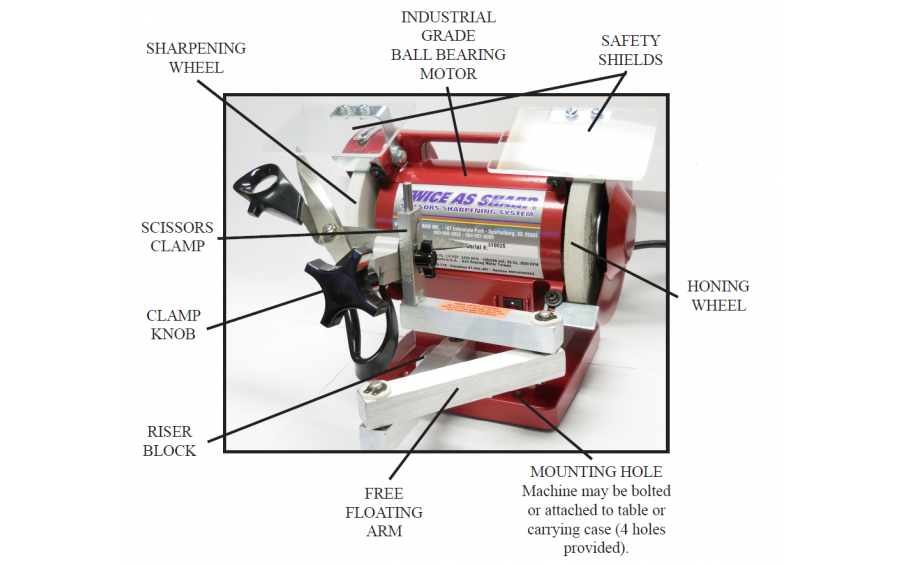
- Sharpening wheel with friable aluminum oxide grain structure to prevent burning blades!
- Free floating arm system and double sealed Rulon® bearings for years of maintenance free use.
- Original Twice as Sharp® Standard Shears-Lock Clamp that accommodates many blade types, shapes, sizes, tapers, and angles.
- Eye shields, wheel covers, and finger guards for safety.
Did you notice?
- The sharpener can make your scissors 2 to 6 times sharper than new!
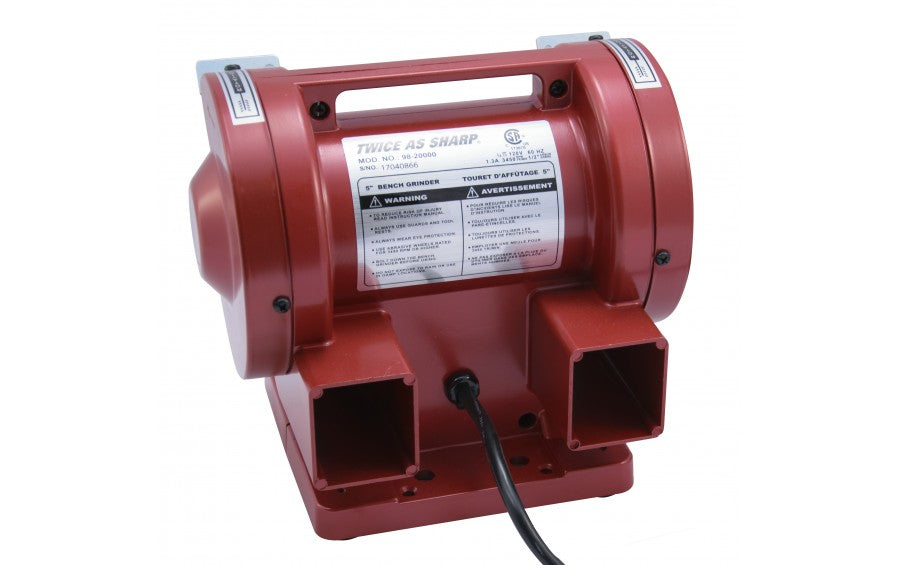
- The Twice as Sharp® dust ports made for use with the DC-1000 Dust Collector or adaptor rings.
- The Professional model is equipped with a professional honing wheel
- The CSA electrical rating.
- The Professional model can be rewired for 220 V use.
Recommended For
Pet grooming shears, high quality fabric shears, low priced barber and beauty shears.
High or low volume scissors sharpening
Retail, home, or industrial use
What's in the Box?
Twice as Sharp® Standard Scissors Sharpener
Standard Sharpening Wheel
Professional Honing Wheel
Standard Shears-Lock Clamp
Angle Gage
Pink Hone
Scissors Lubricant
Wheel Dresser
Hex Wrench
Sales Poster
Eyeshields
Safety Glasses
Dust Mask
Operator's Manual
Training DVD
Technical Specifications
- Item Weight - 12 lbs
- Shipping Weight - 14 lbs
- Shipping - Boxed
- Package Dimensions - 11 x 10 x 10
- Power Source - Corded Electric
- Plug Type - 3 Pin Type B, 2 Pin
- Voltage - 110 V, 220 V
- Amperage - 1.3 A
- Wattage - 375
- Frequency - 60 Hz, 50 Hz
- Speed - 3450 rpm, 3000 rpm
- Phase - 1
- Horsepower - 1/4 hp
- Motor - condenser run, TENV 100% duty cycle
- Bearings - Precision double-sealed (SKF 6202-2RS1 or equivalent) ball bearings
- Wheel Diameter - 5 in
- Wheel Bore - 0.5 in
- Wheel Face - 0.5 in
- Standard Sharpening Wheel - 100 grit fine grain friable aluminum oxide
- Professional Honing Wheel - 600 grit cotton impregnated with fine silicon carbide
- Sharpening Angles - 0 to 55 degrees
- Clamp Opening - 0.6 in
- Arm Assembly - double sealed Rulon® bearings
CSA Certified - CSA C22.2 No 71.2-M89 - Electric Bench Tools and UL 987, Sixth Edition - Stationary and Fixed Electric Tools
U.S. Patent # 4,528,778
Canadian Patent # 1 243 487
German Patent # DE 3490 065 C2
Specifications subject to change without notice
Origin
Components - Manufactured and Assembled with pride in the U.S.A.
Ball Bearing Motor - Manufactured in Taiwan
Warranty
Buy with confidence. Wolff Industries, Inc. Twice as Sharp® scissors sharpeners come with our best warranties.
30 Day Money Back Guarantee: If you are not completely satisfied, return the item(s) within 30 days to receive a prompt refund. Returns after 30 days are subject to a 10% restocking fee. Wolff Industries, Inc. reserves the right to make changes or improvements on its products without incurring an additional obligation to make corresponding changes or improvements to products previously manufactured or sold. Wolff Industries, Inc. reserves the right to discontinue products at any time without notice.
Limited Warranty: Two year warranty from date of purchase against defective parts or workmanship with the exception of the sharpening, buffing, honing and polishing wheels. Warranty limited to replacement of parts. Buyer must return warranty card to manufacturer for coverage of warranty. This warranty covers only the original purchaser. Use of non-factory parts voids any warranty. This warranty gives you specific rights. You may also have other rights which may vary from state to state. Some states do not allow limitation or implied warranties or consequential damages, so these may not apply to you.
Disclaimer: There is no expressed warranty other than the limited warranty stated above. There is no implied warranty for the merchantability or for fitness for a particular purpose. Wolff Industries, Inc. will not be responsible for any consequential damages. Damages are limited to the replacement of the defective parts.